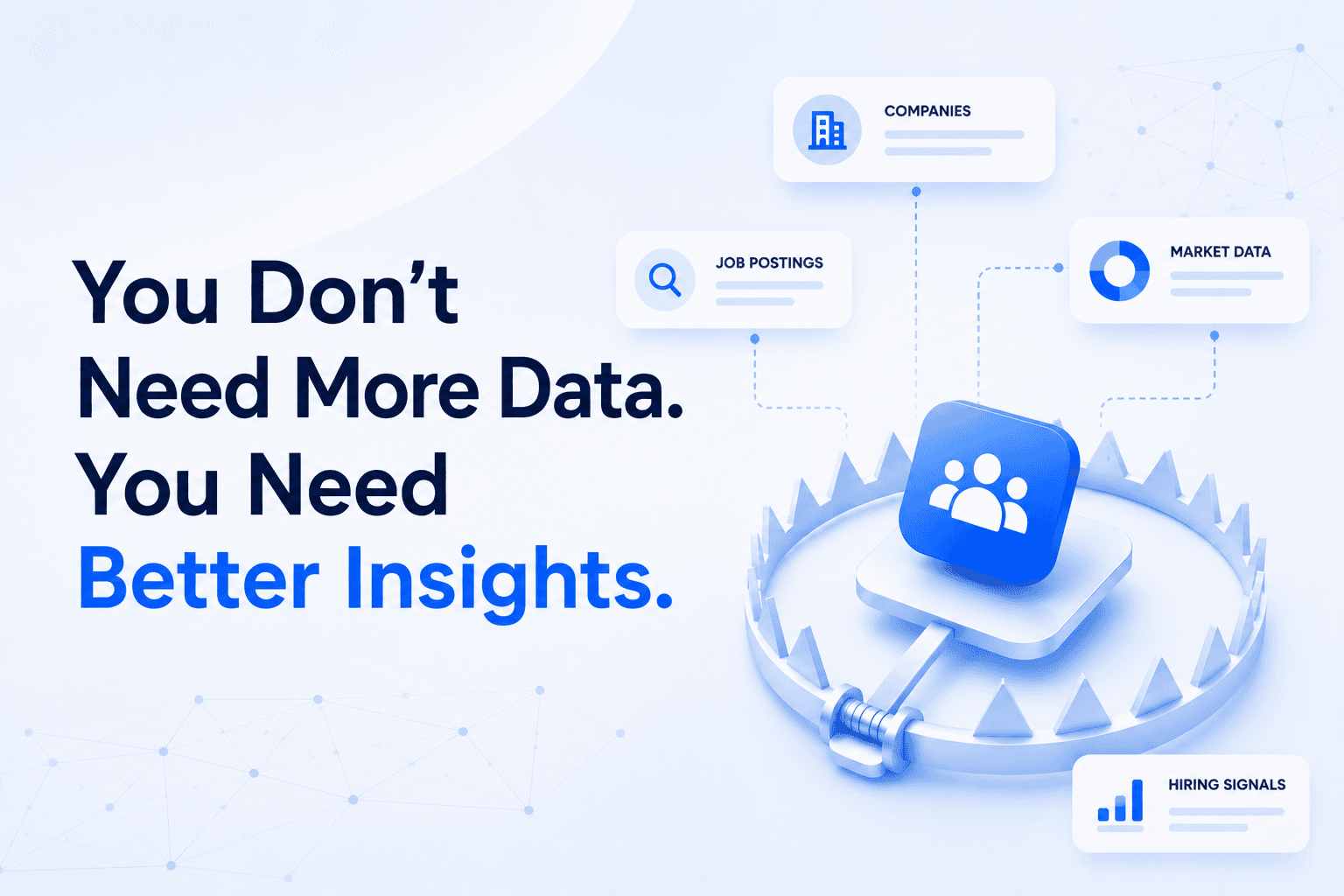
Every day, Tech Talent revenue teams face the same silent frustration: you're swimming in data, but drowning in noise.
Thousands of job postings appear daily. Companies announce hiring. LinkedIn fills with hiring signals. Somewhere in that chaos are real opportunities but they're buried. You could spend all day digging through postings, verifying which companies are actually hiring with urgency, figuring out who matters at each company, and crafting relevant outreach. Or you could close deals.
It's tempting to think AI solves this instantly. It can analyze anything. Surely you can just ask it, "Who's hiring right now?" and let it work through the noise while you focus on conversion.
That's where teams get stuck. And that's what we're exploring in this article.
What Is an AI Wrapper?
An AI wrapper isn't inherently bad. It's just limited.
A wrapper is, essentially, a simple interface around a larger tool. Think of it like this: you take a language model (ChatGPT, Claude, whatever), you ask it to answer a question, and you show the answer to the user.
That's it. Here's what a basic wrapper does:
- User types a prompt or question
- That prompt gets sent to a language model
- The model generates an answer
- The answer appears on screen
It's lightweight. It's fast to build. You could theoretically prototype this in a weekend.
Here's what it doesn't do:
- Understand your specific business context
- Maintain consistent data across sessions
- Make smart decisions about which question to answer first
- Remember what matters to each user
- Connect multiple pieces of information into actionable workflows
- Handle sensitive data responsibly
- Scale without constant manual intervention
For many use cases, a wrapper is fine. Customer support chatbots, brainstorming partners, content drafting tools, all these work great as wrappers.
But if you're trying to build a system that drives business decisions, a wrapper can become a liability.
Why Wrappers Fall Apart When You Need Sales Real Insights
You ask it: "Which tech companies in Europe are actively hiring engineers right now?"
It gives you a list. Some good. Some outdated. Some that aren't actually hiring urgently, they're just keeping postings live. You spend time verifying. You manually cross-reference. You try to figure out which opportunities are worth your time.
Next day, you ask again. Different list. Some repeats from yesterday. Some that have closed. Some you've already worked on but the AI doesn't remember. You're back to manual verification.
By mid-week, you're spending half your time sorting through AI suggestions instead of having intelligent conversations with buyers. The noise hasn't gone away, it's just shifted. Your AI wrapper threw 200 companies at you; now you manually filter to the 10 that matter. That's not automation. That's delegation.
The deeper problem: You're asking ChatGPT or Claude to solve a sales problem, and it's designed for conversation, not continuous market analysis. It has no memory of what you've already worked. It doesn't know which signals indicate real hiring urgency. It can't distinguish a stale posting from an active one. It doesn't track likelihood of conversion. It can't prioritise, it just generates lists.
So you end up doing the hard thinking anyway. Manually.
Getting True Insights is Harder Than it Looks
Building an AI-Native Sales Talent Revenue platform that actually works requires more than a prompt box. It requires layers that most wrappers don't touch:
Layer 1: Data Verification
You need to know which companies are actually hiring right now with real urgency—not last month, not speculation, not just keeping postings live. That means aggregating job postings from multiple sources, normalising the data, filtering out stale or duplicate postings, and enriching each role with structured data (skills, seniority, location, sector, hiring velocity).
A wrapper doesn't do this. It waits for the user to bring context.
A real sales intelligence platform builds and maintains this layer continuously. New job postings come in daily. They're analysed for freshness, deduplicated, enriched with skills extraction, matched against historical hiring patterns, and ranked by recency and company activity signals.
Without this layer, you're asking sales teams to find demand signals themselves. With it, the system brings verified opportunities to them.
Layer 2: Personalized Ranking
Not all opportunities are equal. And what matters depends on what you're trying to achieve.
A sales team focusing on fintech cares about sector alignment. One opening a new geography cares about companies with hiring velocity. Another cares about decision-maker engagement signals. One is focused on volume; another prioritises conversion likelihood.
A generic wrapper treats all opportunities the same. A sales intelligence platform ranks by your specific focus: location, sector, hiring signals, seniority, skills, team composition, company hiring patterns.
This ranking layer turns raw data into a prioritised work-list. Instead of "here are 10,000 opportunities," it says "here are the top 10 that match your market focus." That might be "fintech companies actively hiring Python engineers in London." Or "high-velocity companies where you haven't prospected yet." Or "companies with recently appointed hiring managers in your target sector."
Layer 3: Account & Buyer Intelligence
Finding a job posting is one thing. Knowing who matters at that company is another.
Generic AI can suggest titles ("try contacting the VP of Engineering"). A real sales intelligence platform integrates account and buyer data with your sales workflow, it identifies the early-stage signals in a company and the likely stakeholders for this specific opportunity, ranks them by relevance to your pitch, and provides context (their role, what they care about, how to reach them).
A wrapper would help you draft a generic email. A sales intelligence platform connects you to the right person with the right context at the right time!
Layer 4: Sales Workflow and Memory
Sales isn't a single question. It's a series of decisions.
You identify an opportunity. You research the company. You identify the decision-maker. You draft outreach. You follow up. You manage conversations. You move the opportunity forward or archive it.
A wrapper has no memory of that process. Each interaction starts from scratch. You can't track where you are with each company. You can't see patterns. You can't prioritise follow-ups.
A sales intelligence platform maintains workflow state. It remembers which companies you're pursuing and connects market intelligence, opportunity context and buyer context into one coherent view.
What Talent Sales Intelligence Actually Looks Like
It's not a generic AI with a nicer interface.
It's a system that:
- Brings opportunities to you, not the other way around. Instead of you asking questions, the system identifies active hiring demand, filters for fit with your market focus, and serves a prioritised list of the opportunities worth your time. No noise. No verification work. Just clarity on where the real activity is.
- Understands your market. It knows what you focus on. Which sectors, geographies, company sizes, or hiring signals matter to you. It uses that context to rank and filter automatically. You see only what's relevant to your business.
- Account Intelligence. It does deep research for any account, but not like any LLM would do today. It actually identifies only the meaningful to you and your company external market signals and it combines them with the historical talent dynamics creating a unique insight into the past, present and expected future opportunities in that account.
- Connects all the dots. It links market intelligence, account context, buyer information, and your conversation history into one coherent view. No more switching between five different tools and spreadsheets.
- Generates conversation-ready context. It doesn't just generate text. It generates outreach messages, opportunity summaries, and buyer context tailored to each specific opportunity and your market.
- Maintains state and memory. It remembers which companies you're pursuing, which conversations are active, which opportunities need follow-up. Your pipeline is clear. You know exactly where you are with each prospect.
- Handles sensitive data carefully. It's designed from the ground up to avoid unnecessary PII storage, manage consent, support GDPR, and provide transparency about data use.
- Scales with your operation. As you add team members, the system scales. New team members inherit collective intelligence (market trends, buyer context, opportunity history). They ramp up faster.
The Business Case
Let's talk about what this actually means for your business.
Without meaningful sales insights:
- 5-8 hours per week verifying which companies are actually hiring
- 3-4 hours researching decision-makers at target companies
- 2-3 hours managing scattered conversations across email, LinkedIn, CRM
- Response rates of <2% (typical for cold outreach)
- Long sales cycles because you're prospecting broadly instead of intelligently
- Constant noise and context-switching killing productivity
With true tech talent market insights:
- Daily personally ranked verified opportunities
- Account intelligence at your fingertips
- Buyer context already researched and provided
- Outreach customised to each company and relevant buyer
- Response rates of 15-20% (from cold to relevant outreach)
- Faster sales cycles (focused energy on high-probability opportunities)
For a sales team of 5 people spending an average of 10 hours per week on research and low-quality prospecting, that's 50 hours per week reclaimed. At blended labour costs of $50,000+ per year, that's roughly $25,000-$30,000 per year in recovered productivity.
But the real impact is revenue acceleration. Faster cycles. Higher conversion rates. Fewer missed opportunities because you're working warm leads instead of cold. For a team managing $2M+ in annual placements, that efficiency compounds quickly.
The Takeaway
AI wrappers are useful tools for many problems. Customer support, content drafting, brainstorming. All these are great wrapper use cases.
But true sales insights are not a wrapper problem.
They are a data problem, a workflow problem, a compliance problem, and a scale problem.
You need to find real opportunities in noisy markets. You need to understand company context and buyer intelligence. You need to convert efficiently. And you need to do it while managing compliance, protecting sensitive data, and keeping your team coordinated.
The systems that solve this are nothing like prompt boxes. They are real AI-Native Workspaces for tech talent revenue teams designed from the ground up to handle opportunity discovery, demand verification, buyer intelligence, and conversion workflows as interconnected pieces.
The teams that win are the ones that move fast. And you move faster when your tools are designed for your workflow, not borrowed from somewhere else.
Curious how an AI-Native Workspace for Tech Talent Revenue teams actually works?
Visit estel.tech to get a glimpse or get your FREE Plan at estel.tech/pricing and start exploring the tech talent markets. We run demos that show the full workflow from verified demand to conversion context to closed deals. Let's talk about how it could accelerate your team's results.